

Selecting an aluminum melting furnace for die casting requires matching its melting rate to the actual metal consumption of the casting machines. Holding capacity, available melting hours, energy consumption, and downstream equipment also affect the final specification.
This guide explains how to calculate the required melting rate in tonnes per hour (t/h) and estimate the necessary molten-metal reserve.
Melt Rate vs. Holding Capacity
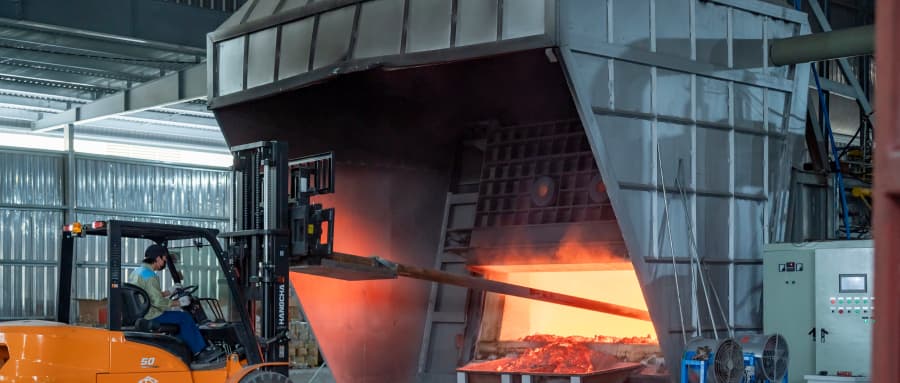
Melting rate and holding capacity are two different furnace specifications:
Melting rate (t/h): The amount of aluminum a furnace can melt per hour. It determines whether the furnace can meet production demand.
Holding capacity (t): The amount of molten aluminum the furnace or holding unit can store at operating temperature. It provides a buffer for continuous production.
A 5-tonne furnace does not necessarily melt more aluminum per hour than a 3-tonne furnace. A smaller furnace with a higher melting rate may better support a high-demand production line.
Furnace design also affects melting performance, energy use, and operating conditions. The main differences between crucible, reverberatory and induction furnace types compared should be considered when evaluating the available options.
Furnace selection should start with hourly metal consumption, followed by the required melting rate and usable holding capacity.
Calculate Aluminum Consumption
The hourly metal consumption of a die casting machine depends on shot weight and production rate.
For multiple machines:
Shot weight must include the complete shot: the casting, runners, overflows, and biscuit, not just the finished component.
The following information is needed:
| Input | Measurement |
|---|---|
| Shot weight | Total metal weight per shot |
| Production rate | Actual shots per hour |
| Machine quantity | Number of machines operating simultaneously |
Casting Yield and Return Aluminum
Casting yield represents the proportion of poured metal that becomes finished castings. Runners, biscuits, and other recoverable material return to the melting process and must be melted again.
For furnace sizing, total shot weight is the starting point for calculating circulating metal throughput. Return aluminum should be considered separately when determining charge composition and fresh metal requirements.
Casting yield and return fraction should not be used interchangeably. Applying both as separate reductions to the same metal consumption figure can result in an incorrect capacity calculation.
Determine the Required Melting Rate
The calculated hourly consumption provides the base melting requirement. Additional capacity may be needed to accommodate charging, skimming, temperature recovery, and production fluctuations.
A preliminary formula is:
A 20–30% buffer can serve as an initial planning allowance. The final allowance should be checked against actual operating conditions and the furnace manufacturer’s performance data.
Furnace availability also matters. The required melting rate must account for the hours during which the furnace is actually melting metal, rather than automatically using the full production shift.
Consider a casting line consuming 5.76 tonnes over an eight-hour shift. Its average metal demand is:
When the furnace operates for only six hours while supplying the same eight-hour production shift, its required average melting output becomes:
Applying a preliminary 25% buffer gives:
The target melting rate in this case is approximately 1.20 t/h. This calculation is particularly relevant to central melting systems that operate for fewer hours than the connected die casting machines.
Calculate Holding Capacity
Holding capacity provides a reserve of molten aluminum between melting and consumption. Its size depends on production continuity, charging frequency, and the time needed for furnace recovery.
A useful preliminary formula is:
For a production line consuming 0.72 t/h, one hour of usable molten-metal reserve requires approximately 0.72 tonnes.
The rated furnace capacity must also account for the minimum operating metal level and maximum safe filling level. The nominal capacity and usable holding capacity are therefore not necessarily the same.
Key considerations include:
1. Peak metal consumption from connected machines
2. Charging and skimming time
3. Temperature recovery after charging
4. Metal transfer distance
5. Required pouring temperature
6. Production interruptions and die changes
The usable holding capacity, rather than the nominal furnace capacity alone, should determine the final specification.
Compare Furnace Energy Consumption
Energy consumption directly affects the operating cost of aluminum melting. The main factors include furnace design, burner efficiency, charge temperature, holding time, insulation, and exhaust heat loss.
The U.S. Department of Energy’s overview of industrial process heating explains how industrial heating systems transfer energy from heat sources, such as burners and electric heaters, to materials during manufacturing.
For a preliminary engineering comparison, the heat required to bring aluminum from room temperature to a molten state can be estimated from its temperature change and melting requirements. A reference value of approximately 316 kWh/t may be used for an illustrative calculation based on heating aluminum from around 20°C to 720°C. Actual values vary with alloy, initial temperature, final metal temperature, and calculation assumptions.
This figure represents heat absorbed by the metal, not the actual energy consumed by an industrial furnace.
Natural Gas Consumption
Using a natural gas lower heating value of 35.6 MJ/Nm³:
Based on the illustrative 316 kWh/t reference:
This is a theoretical fuel-equivalent estimate before furnace heat losses. Actual gas consumption is higher because of exhaust gas, furnace walls, openings, and other heat losses.
The following table illustrates the relationship between gas consumption and implied thermal efficiency under these assumptions.
| Gas Consumption | Implied Thermal Efficiency |
|---|---|
| 45 Nm³/t | Approximately 71% |
| 55 Nm³/t | Approximately 58% |
| 65 Nm³/t | Approximately 49% |
| 80 Nm³/t | Approximately 40% |
| 100 Nm³/t | Approximately 32% |
| 130 Nm³/t | Approximately 25% |
These are calculated comparisons based on the 316 kWh/t reference and 35.6 MJ/Nm³ gas heating value. They are not universal furnace performance benchmarks.
When comparing furnaces, request measured gas or electricity consumption per tonne under clearly specified conditions. The charge material, initial temperature, final metal temperature, and measurement period should be consistent.
Aluminum Melt Loss
Aluminum oxidation and dross formation reduce metal recovery during melting. Charge condition, alloy composition, temperature, and holding time all influence melt loss.
The financial impact can be substantial. At an annual throughput of 5,000 tonnes, a 1% metal loss represents 50 tonnes of aluminum. At an assumed value of €2,200/t, this equals €110,000 in annual metal loss.
Proper temperature control, shorter unnecessary holding periods, and suitable charging and skimming practices help improve metal recovery.
Match the Furnace with Downstream Equipment
An aluminum melting furnace must supply metal at the rate and temperature required by the downstream production line. The capacity of each processing stage should be considered as part of the overall system.
Refining and Degassing
Molten aluminum may require refining, degassing, and inclusion removal before casting. A refining tank or online treatment unit should have sufficient processing capacity to match the furnace output.
For operations requiring a dedicated treatment stage, an aluminum refining tank can be considered as part of the melt treatment system.
Dross Handling
Dross forms during melting and metal handling, particularly when processing recycled aluminum. An aluminum dross separator helps recover metallic aluminum from hot dross and reduce the amount of recoverable metal lost with the residue.
Metal Transfer and Casting
The furnace output must also match the casting equipment’s consumption rate. Launders, transfer systems, and temperature control are important for maintaining stable metal delivery.
For billet and ingot production, the melting and casting equipment should be evaluated as one integrated production system.
Worked Example: Two Die Casting Machines
Consider a production line with two 800-tonne clamping-force die casting machines.
| Item | Value |
|---|---|
| Shot weight | 4 kg |
| Shots per hour per machine | 90 |
| Number of machines | 2 |
| Total shots per hour | 180 |
| Hourly metal consumption | 0.72 t/h |
| Design buffer | 25% |
| Preliminary melting rate | 0.90 t/h |
Calculation:
The preliminary design melting rate is therefore 0.90 t/h, assuming the furnace can melt throughout the production period.
With one hour of usable molten-metal reserve, the initial holding-capacity target is approximately 0.72 tonnes.
If the furnace is available for only six melting hours during an eight-hour production shift, the required rate must be recalculated based on the available melting time. Under that operating schedule, the preliminary target would be 1.20 t/h, as shown in Section 3.
These figures provide a starting point for equipment selection. Final specifications must account for furnace operating hours, charging conditions, temperature requirements, and actual production fluctuations.
Furnace Selection Checklist
Before preparing a furnace RFQ, confirm the following technical information:
1. Actual shot weight, including runners, overflows, and biscuit.
2. Production rate of each die casting machine.
3. Number of machines operating simultaneously.
4. Daily production hours and available furnace melting hours.
5. Return aluminum percentage and expected melt loss.
6. Required molten-metal temperature.
7. Usable holding capacity and charging frequency.
8. Gas consumption or electrical energy consumption per tonne.
9. Furnace charging method and material condition.
10. Downstream equipment capacity and metal transfer requirements.
Complete production data allows furnace manufacturers to calculate the required melting rate, holding capacity, and heating configuration more accurately.
Choosing an Aluminum Melting Furnace for Die Casting
The right aluminum melting furnace must match actual production demand, not simply provide a large holding capacity. Melting rate, usable metal reserve, energy consumption, and compatibility with downstream equipment are the main factors in selecting a suitable system.
Explore our aluminum melting furnace for industrial aluminum melting and holding applications, including its available configurations and technical specifications.
Request a Furnace Sizing Calculation
For a preliminary furnace sizing assessment, prepare your shot weight, actual production rate, number of operating machines, and daily melting hours.
Contact us to discuss your aluminum melting requirements and equipment configuration.
Post time: Nov-25-2026