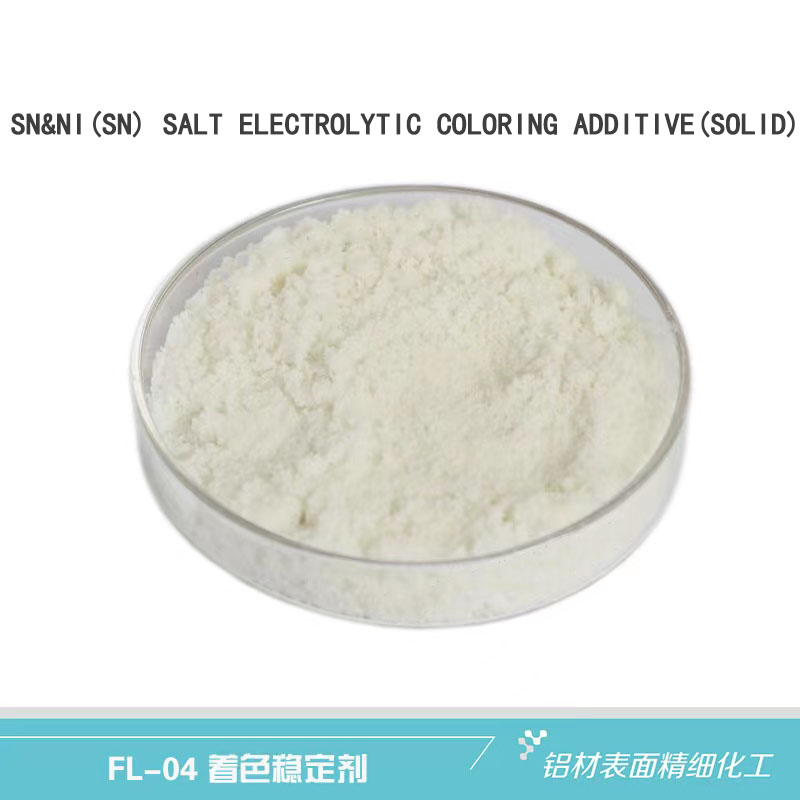
Chinese wholesale Block Holding - Sn&Ni Salt Electrolytic Coloring Additive for anodizing – ZheLu
Chinese wholesale Block Holding - Sn&Ni Salt Electrolytic Coloring Additive for anodizing – ZheLu Detail:
1. Analyze the bath solution daily,determine the concentrations of free sulfuric acid,stannous sulfate, nickel sulfate and total acid,replenish in time.
2. The additions scale of stannous sulfate to Sn&Ni Salt Electrolytic Coloring Additive is 1:1.1~1.2.
3. There will be white precipitations in long-time production, so the bath solution should be filtered and cleaned regularly.
is sealed with polybag, 5kg net each and 4 polybags in carton,20kg net each. Protected from light in a dry place.
Determination of stannous sulfate (SnSO4) content
Required reagents
①1% starch solution ② 0.1N iodine standard solution
Assay steps
Accurately draw 10mL of the test solution into a 250mL triangular beaker, add 100mL of water, add 5mL of 1:1 hydrochloric acid, and then add 5mL of 1% starch indicator, quickly titrate with 0.1N iodine standard solution, the solution turns from colorless to blue The color is the end point, and the volume V of the standard solution consumed is recorded.
calculate
Stannous sulfate (g/L)=10.73 × V × N
Determination of nickel sulfate (NiSO4) content
Required reagents
①30% hydrogen peroxide
②10% potassium sodium tartrate
③ 1:1 ammonia water
④1% purpuric acid amine
2. Assay steps
Take 1mL of coloring bath solution into a 250mL triangular conical flask, add 2mL (30%) hydrogen peroxide, heat to near dryness, add about 80mL water after cooling, 10mL (10%) potassium sodium tartrate, 20mL (1:1) ammonia water, A small amount of 1% ammonium purpurate was titrated with 0.01N EDTA standard solution until the solution turned purple as the end point.
calculate
Nickel sulfate (g/L)=262.9 × V × N Determination of total acid (H, SO)
1. Required reagents
0.1% Bromothymol Blue
② 1NNaOH standard solution 2. Assay steps
Accurately draw 10mL of the test solution into a 250mL triangular beaker, and add about 100mL of water. Add 4 drops of 0.1% bromothymol blue indicator, titrate with 1N NaOH standard solution, change from yellow to cyan as the end point, and record the volume V of NaOH consumed.
3. Calculate the total acid (
g/L)=4.9xVxN
Champagne coloring sink 2 — assay method
Determination of free acid (H2SO4)
Required reagents 1N NaOH standard solution
2. Assay steps
Accurately draw 50mL of the test solution into a 100mL beaker, titrate the pH to 2.1 with 1N NaOH standard solution under the measurement of the acidity meter, and record the consumed volume V.
calculate
Free acid ((g/L)=4.9 × V × N/5
Process parameters
Tin & Nickel Double Salt Electrolytic Coloring
| stannous sulfate | Nickel sulfate | free acid | P H | Voltage | temperature |
| 5~10g/L | 16~20g/L | 16~21g/L | 0.8~1.2 | 14~18V | 1 8~23℃ |
|
stannous sulfate |
free acid |
P H |
Voltage |
temperature |
|
6 to 1 2 g/L |
16~21g/L |
0.8~1.2 |
1 6 ~18V |
1 8~23℃ |
Product detail pictures:


Related Product Guide:
The company has set branches and warehouses in Hanoi and Ho Chi Minh, Vietnam.Yearly we exports there more than 6,000 tons of casting and extrusion consumables ,as well as dozens of casting and extrusion production lines. In the future, we will set up our branch offices in more countries, through face-to-face communication with customers, we will provide door-to-door one-stop service to our customers to solve all the problems. Chinese wholesale Block Holding - Sn&Ni Salt Electrolytic Coloring Additive for anodizing – ZheLu , The product will supply to all over the world, such as: Sacramento, Gambia, Hamburg, Aluminum is the metal of the future, it is not only environmentally friendly, light weight, natural corrosion resistance, high strength, but also good thermal and electrical conductivity.Characteristics of aluminum profiles: durable. Aluminum's corrosion resistance, corrosion resistance and weathering resistance are among its most significant advantages. Aluminum does not require additional treatment to rust naturally and resist corrosion. This is due to the presence of a thin, naturally occurring protective film of alumina on its surface. Through anodizing, its corrosion resistance becomes stronger.
 By Danny from
Luxembourg -
2017.04.18 16:45
The company has a good reputation in this industry, and finally it tured out that choose them is a good choice.
By Lorraine from
Lithuania -
2017.12.09 14:01