
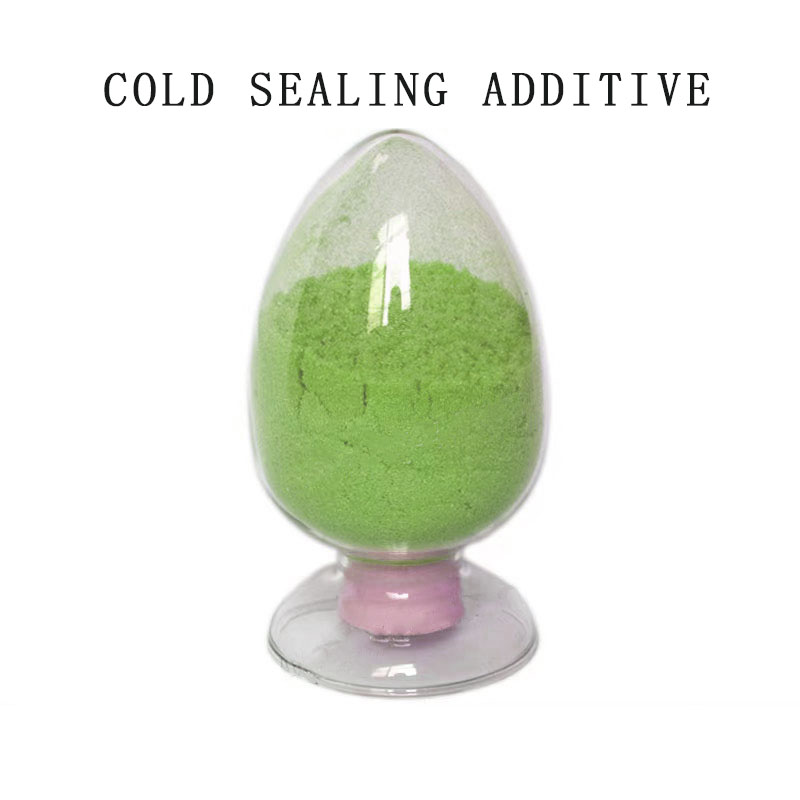
China Supplier Refractory Tubes - Liquid And Solid Cold Sealing Additive For Anodizing – ZheLu
China Supplier Refractory Tubes - Liquid And Solid Cold Sealing Additive For Anodizing – ZheLu Detail:
1. Excellent resistance to impurities and good buffering capacity to acid and alkali.
2. The solution has advantages of easy to operate, a wide range of process parameters, no need to adjust the pH frequently.
3. Prevent the sealing boom from happening.
4. After the sealing treatment, it can improve the surface hardness and gloss of aluminum profiles.
| Cold Sealing Additive | Deionized water |
| 5~5.5g/L | Balance |
|
Ni2+ |
F- |
pH |
Temperature |
Time |
Consumption |
|
0.9~1.3g/L |
0.4~0.6g/L |
5.5~6.5 |
22~28℃ |
1μm/1.3min |
0.9~1.5kg/T |
1. Determine the concentrations of Ni,F and pH, make them within the range of the process parameters
2. Regulate the pH by adding dilute acetic acid (dilute hydrofluoric acid) or dilute sodium hydroxide (dilute ammonia),keep pH value between 5.5 and 6.5.
3. For reducing the pollution of the rinsing bath solution, control the water quality and pH of the rinsing bath strictly,the pH can not less than 4.5.
Cold Sealing Additive is sealed with polybag, 5kg net each and 4 polybags in carton, 20kg net each. Protected from light in a dry place.
Determination of nickel ion (Ni2+) content
1. Assay steps.
Accurately draw 10mL of the sink liquid into a 250mL triangular beaker, add 50mL of water, 10mL (pH=10) of chloramine buffer, a small amount of 1% violetine, and shake well. Titrate with 0.01mol/L EDTA standard solution until the solution changes from yellow to purple as the end point, and record the consumption volume V.
2. Calculation: Nickel(g/L)=5.869 × V × C
V: the volume of EDTA standard solution consumed in milliliters (mL)
C: molar concentration of EDTA standard solution (mol/L)
1. Preparation of F- standard solution
① Standard solution with F- concentration of 5g/L: Accurately weigh 11.0526g NaF (Analytical Reagent, dry in an oven at 120°C for 2h, store in a desiccator with a weighing bottle for use, accurate to 0.0001g when weighing) to dissolve In a small amount of distilled water, transfer to a 1000mL volumetric flask, dilute to the mark, and shake well.
② Standard solution with F- concentration of 0.1g/L: Pipette 10mL of the standard solution with F- concentration of 5g/L in the above volumetric flask into a 500mL volumetric flask, dilute to the mark, and store in a polyethylene bottle.
③ Prepare standard solutions with F- concentrations of 0.2-1 g/L as described above.
2. Preparation of Total Ionic Strength Adjusting Buffer Solution (TISAB)
Take about 500mL of distilled water and put it in a 1L clean glass beaker, add 57mL of glacial acetic acid, and then add 58.5g of sodium chloride and 12g of sodium citrate to fix and dissolve completely, and then use analytically pure sodium hydroxide to adjust to pH=5.0~5.5, dilute to 1L with distilled water.
3. F- Standard curve drawing
① Pipette 2mL of standard solution with a concentration of 0.1g/L into a 100mL plastic beaker, then add 20mL TISAB buffer solution, put in a magnet, stir on a magnetic stirrer, insert oxygen electrode and reference electrode respectively, After electromagnetic stirring for 3min, stand for 30s, and read the equilibrium potential Ex;
②Use the same method to measure the potential value Ex of the standard solution whose F concentration is 0.2~1g/L, and sort the concentration from low to high. On the graph paper, draw the E-F standard curve with the potential E as the ordinate and the F concentration as the abscissa.
4. Determination process
Accurately pipette 20mL of the sink liquid into a 100mL beaker, add 20mL of total ionic strength buffer (TISAB), stir on a magnetic stirrer for 3min, and directly measure the potential difference mv with a fluorine electrode. Find the corresponding fluorine content m in the fluorine content-potential difference standard electrode diagram .
Process parameters
| Cold Sealing Additive | Nickel ion | Fluoride | PH | temperature |
| 0.9~1.3g/L | 0.4 – 0.6g/L | 5.5-6.5 | 22 ~ 28℃ |
Product detail pictures:
Related Product Guide:
Foshan Zhelu Trading Co., Ltd. is an export enterprise in the aluminum casting and extrusion industry for more than 20 years, and is also a manufacturer of aluminum casting and extrusion consumable materials. It mainly produces aluminum refining flux, drossing flux, ceramic foam filter plates, aluminum silicate stopper cone, aluminum titanium boron wires, castables, felt sleeves and felt belts and other consumables. More importantly, our company as an aluminum plant service company, to help many overseas enterprises to build a new aluminum ingot / aluminum billet production line, aluminum profile production line, powder coating production line and anodizing production line, with the most professional technology and high-quality products to win the trust and support of all aluminum plants, we have a professional installation engineering team and the most thoughtful commissioning services, to help the new aluminum plant quickly put into production and generate income, our ultimate goal is to let each aluminum plant can obtain their own profit stably and efficiently. China Supplier Refractory Tubes - Liquid And Solid Cold Sealing Additive For Anodizing – ZheLu , The product will supply to all over the world, such as: Morocco, Lithuania, New Zealand, Under the action of pressure, the heated aluminum rod is divided into several metal flows, enters the welding chamber through the shunt hole, collects in the welding chamber, and is welded again in the environment of high temperature, high pressure and high vacuum, and finally flows out through the gap between the mold core and the die hole, so as to form a pipe or hollow aluminum profile that meets the size and performance requirements, as an aluminum door and window profile or industrial aluminum profile. If bending is required, a bending tool is added to the rear device.
 By Natalie from
Zimbabwe -
2017.09.09 10:18
The company account manager has a wealth of industry knowledge and experience, he could provide appropriate program according our needs and speak English fluently.
By Marguerite from
Korea -
2018.06.26 19:27
Products categories
-
Top Quality Refractory Supplies - Aluminium ti...
-
Massive Selection for Hot Top Billet Casting Pl...
-

Factory directly Aluminum Glazing Extrusions -...
-
Bottom price Graham Personnel Services Drug Tes...
-
Professional China Extrusion Die Manufacturing ...
-
18 Years Factory Aluminum Profile Painting Line...